AI Automation Consultation
Clarify business goals, operational pain points, current systems, risk tolerance, and the workflows most likely to benefit from agents.
- Executive use-case framing
- Automation fit discussion
- Initial risk and feasibility view
Kivik Digital Group helps leaders assess automation opportunities, design agent-ready workflows, build secure AI agents, integrate existing systems, train teams, and continuously optimize the operating model.
Many AI projects stall because they stop at chatbots, demos, or isolated prompts. Kivik focuses on the operating layer: how work enters the business, how decisions are made, how systems are updated, where people approve, and how performance is measured after launch.
Strong providers do more than advertise agents. They explain strategy, process discovery, business case, workflow build, integrations, governance, training, production monitoring, and ongoing managed improvement.
Kivik can start with a focused automation assessment or lead the full path through strategy, build, deployment, training, and managed optimization.
Clarify business goals, operational pain points, current systems, risk tolerance, and the workflows most likely to benefit from agents.
Map processes end to end, identify bottlenecks, review data quality, and score candidates by ROI, complexity, controls, and timeline.
Design the operating model for each automation: agent roles, tools, permissions, prompts, knowledge sources, human gates, and failure handling.
Build agents that can reason over business context, call approved tools, update systems, draft or complete work, and escalate exceptions.
Connect agent workflows to the places where work already happens, including CRM, ERP, email, documents, databases, websites, and SaaS tools.
Launch safely with users, monitor performance, improve prompts and workflow logic, and scale the automation portfolio over time.
Kivik balances speed with operational discipline. The goal is to move quickly, but only through workflows that are understood, observable, and safe to run.
These are not generic chatbot ideas. Each use case connects intake, decisions, systems, human review, and measurable operational output.
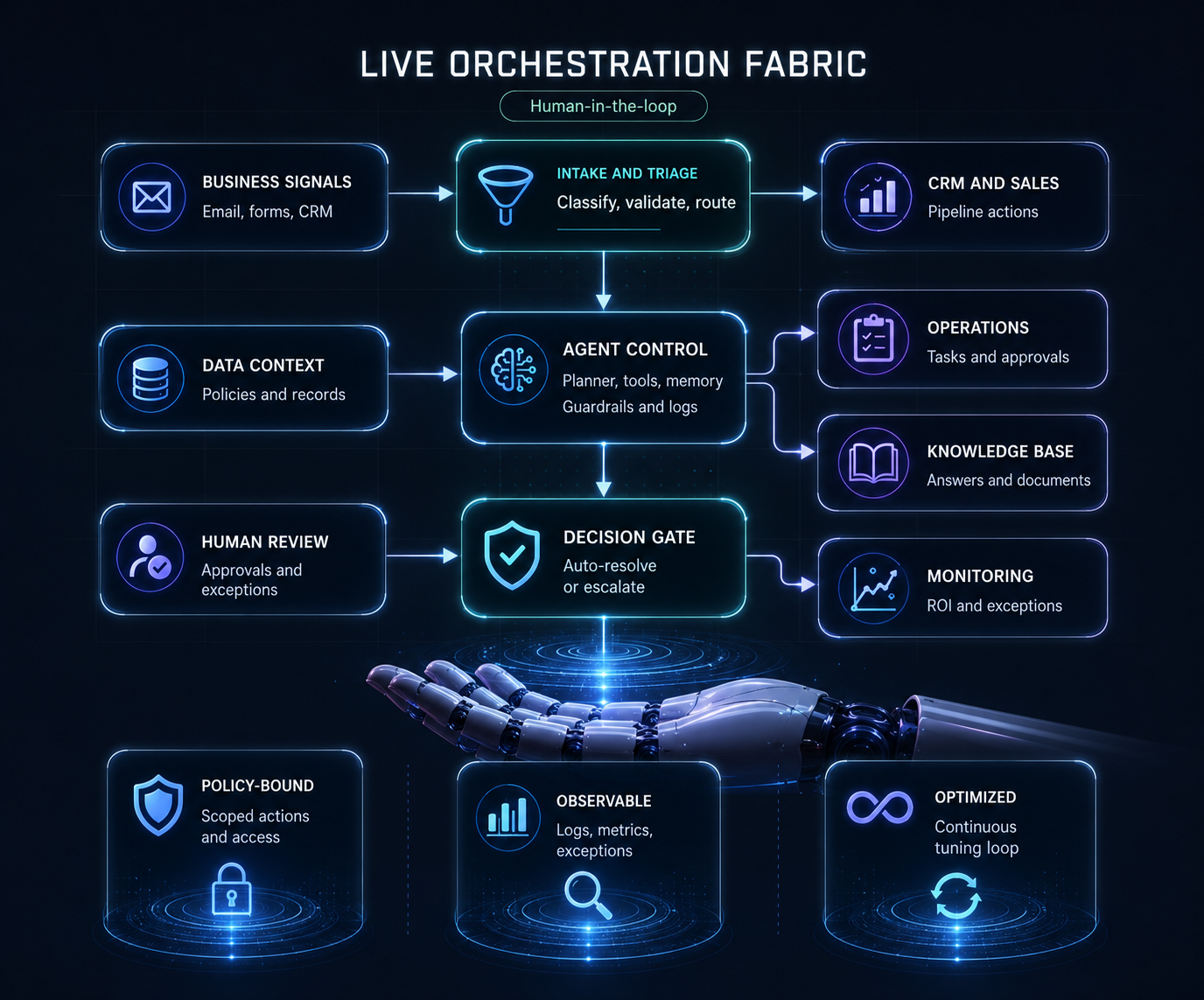
Agentic automation needs more than clever prompts. Kivik designs for operational confidence: access boundaries, human checkpoints, auditability, fallback behavior, and performance review.
Agents are scoped to approved tools, data, and actions so they operate within clear business boundaries.
Automation should be inspectable. Kivik designs logs, status views, error capture, and exception review into the operating layer.
The best systems automate routine work and bring people in when judgment, risk, or customer sensitivity requires it.
Kivik is not limited to one automation surface. The right architecture may combine AI agents, workflow automation, API integrations, retrieval, document processing, reporting, and human review in one coordinated system.
Task-specific agents with instructions, memory, tools, constraints, and clear escalation behavior.
Repeatable workflows, triggers, routing, validation, queue handling, and business logic.
Connections to CRM, ERP, databases, documents, email, websites, collaboration tools, and custom systems.
Start with an assessment of your highest-friction workflows, then turn the best opportunities into a practical build plan with timeline, controls, integrations, and measurable outcomes.